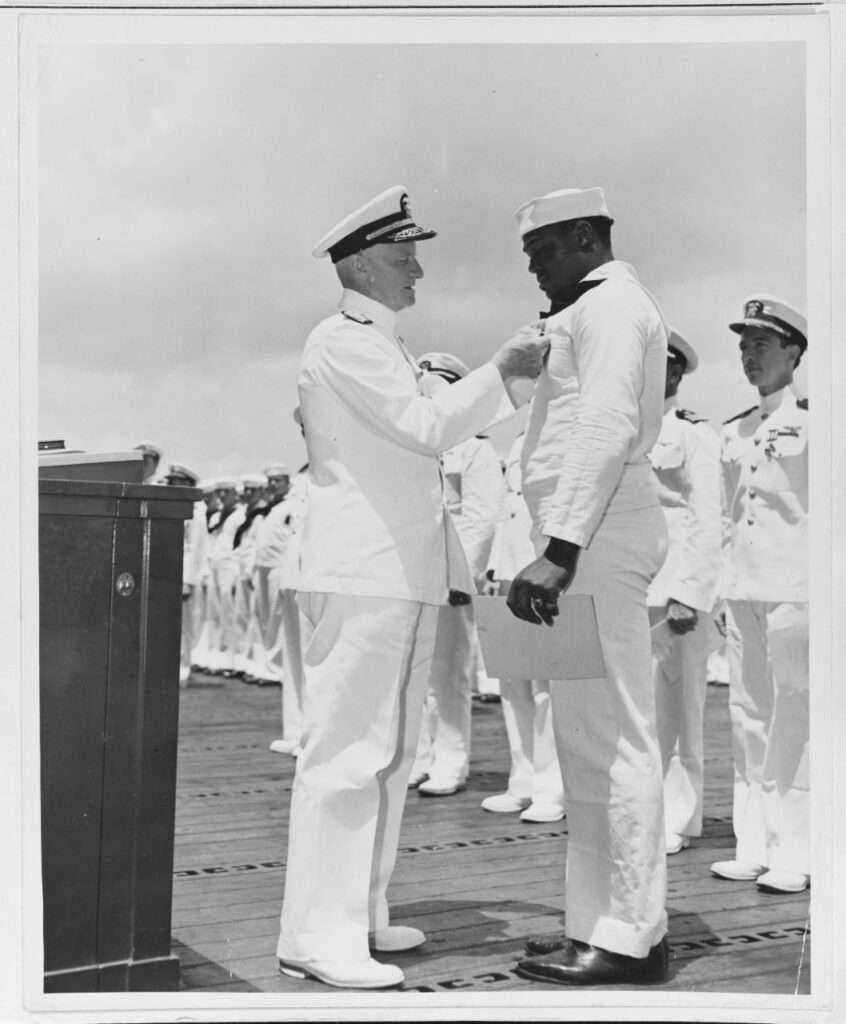
On the morning of May 27, 1942, Admiral Chester W. Nimitz stepped onto the flight deck of USS Enterprise (CV-6) at Pearl Harbor to pin the Navy Cross on a mess attendant. It was, by any measure, the worst possible week for a ceremony. Nimitz held it anyway.
A ceremony squeezed between crises
Enterprise had returned to Pearl Harbor the day before, still salt-stained from the Coral Sea deployment. Within roughly forty-eight hours she would sortie again — under Rear Admiral Raymond Spruance, because Halsey was in the hospital — toward a rendezvous northeast of Midway that Nimitz had staked the Pacific Fleet on. At that exact moment he was making the highest-risk decision of his career on the strength of his codebreakers’ estimates.
In the middle of that, he made time to decorate Doris Miller.
What Miller had done
At Pearl Harbor on December 7, 1941, Miller was a Mess Attendant Second Class aboard the battleship USS West Virginia — a rating that was, under Navy policy of the day, effectively the ceiling for Black sailors. When the attack came he could not reach his assigned battle station. He helped carry his mortally wounded captain, Mervyn Bennion, off the bridge, then began passing ammunition. Then, untrained on the weapon, he manned an unattended .50-caliber anti-aircraft gun and fired until the ammunition ran out and the order came to abandon ship.
For months the Navy did not name him. Black newspapers — the Pittsburgh Courier foremost among them — and the NAACP forced his identity into public view. A congressional push for the Medal of Honor failed; President Roosevelt approved the Navy Cross instead.
What Nimitz said
The citation recognized Miller’s
“distinguished devotion to duty, extraordinary courage and disregard for his own personal safety during the attack on the Fleet in Pearl Harbor.”
Navy Cross citation, Doris Miller
Nimitz added his own words:
“This marks the first time in this conflict that such high tribute has been made in the Pacific Fleet to a member of his race, and I’m sure that the future will see others similarly honored for brave acts.”
Admiral Chester W. Nimitz, May 27, 1942
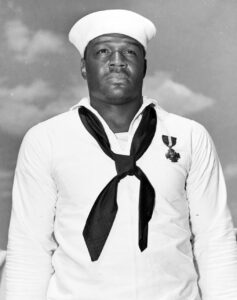
Read plainly, that is a fleet commander stating on the record that the Navy’s racial ceiling had just been proven wrong — and predicting, correctly, that it would keep being proven wrong. Miller was the first Black American to receive the Navy Cross.
Why it belongs in the Nimitz story
Nimitz is usually studied for what he decided: Midway, the two-pronged advance across the Pacific, the officers he kept and the ones he sent home. This is a smaller kind of evidence — the sort of thing a commander does when no operational necessity requires it. He could have delegated the presentation. He could have postponed it until after Midway. Instead he put the Navy’s second-highest decoration on a mess attendant’s chest, in front of a carrier’s crew, days before that carrier sailed into the turning point of the Pacific war.
Miller was later advanced in rating and served aboard the escort carrier USS Liscome Bay. She was torpedoed off Butaritari on November 24, 1943, and Miller was among the more than 600 men lost. He was 24. His parents were notified on the second anniversary of Pearl Harbor.
In 2020 the Navy announced that a Gerald R. Ford-class aircraft carrier would be named USS Doris Miller — the first carrier named for an enlisted sailor, and the first named for a Black American.
Sources
- Naval History and Heritage Command, photo NH 62656
- Naval History and Heritage Command, “Miller, Doris” biography
- U.S. Department of Veterans Affairs, “Doris Miller — Above and beyond the call of duty”
- U.S. Naval Institute, “A Black Hero’s Courage Under Fire,” Naval History, February 2016
- Library of Congress, LC-USZ62-31712