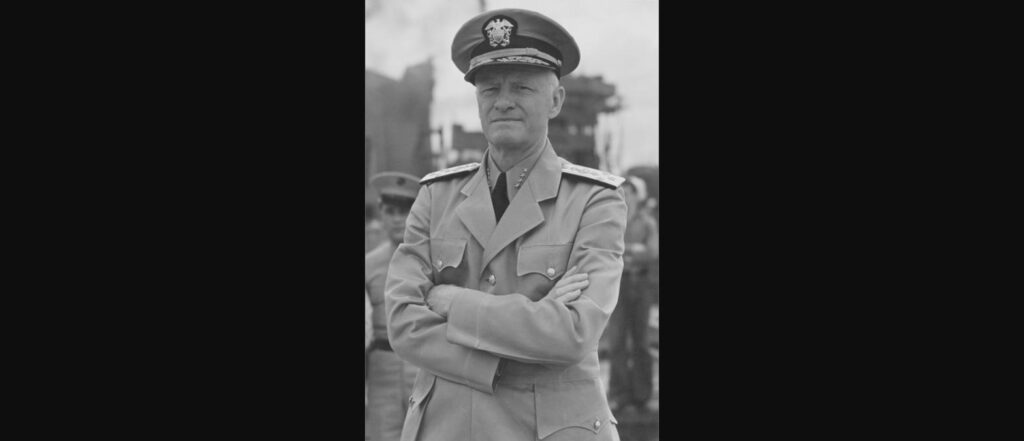
Image Source: U.S. Navy
Chester William Nimitz was born February 24, 1885, in Fredericksburg, Texas, a small Hill Country community founded by German immigrants — a heritage that shaped his famously understated, disciplined temperament. He entered the U.S. Naval Academy at Annapolis in 1901 and graduated in 1905, ranking near the top of his class, launching a naval career that would span more than four decades and two world wars.
Nimitz built his early reputation in the submarine service, commanding several of the Navy’s first underwater vessels at a time when submarine warfare was still an emerging discipline. He became one of the Navy’s foremost authorities on diesel propulsion and later pioneered underway replenishment techniques — methods for refueling ships at sea — that would prove indispensable to sustained naval operations in the vast Pacific theater decades later. By 1939 he was serving as Chief of the Bureau of Navigation in Washington, overseeing personnel policy for the entire Navy.
The attack on Pearl Harbor on December 7, 1941, changed the course of his career. Ten days later he was selected to command the Pacific Fleet, and he formally took charge on December 31, 1941, at a moment when the fleet had just suffered its most devastating blow in history. Over the next four years he directed the Allied naval campaign across the Pacific, overseeing the victory at Midway, the long island-hopping advance through the Central Pacific, and ultimately the defeat of Imperial Japan. He was promoted to the newly created five-star rank of Fleet Admiral in December 1944 and stood among the signatories representing the United States at Japan’s formal surrender aboard USS Missouri on September 2, 1945.
Following the war, Nimitz served as Chief of Naval Operations from 1945 to 1947, guiding the Navy’s transition to peacetime. In later years he undertook diplomatic work for the United Nations and served as a regent of the University of California, remaining a quiet, private figure despite his stature. He died on February 20, 1966. Today his legacy is preserved in his Fredericksburg hometown at the National Museum of the Pacific War, and his name lives on in the Nimitz-class aircraft carriers that patrol the world’s oceans.